This is paragraph text. Click it or hit the Manage Text button to change the font, color, size, format, and more. To set up site-wide paragraph and title styles, go to Site Theme.
How Many Quit Smoking Hypnotherapy Sessions Does It Usually Take?

If you are asking this question, you are probably trying to protect yourself from disappointment.
That makes sense.
A lot of people do not want to get pulled into one more hopeful promise, only to find out later that the reality is very different. If you are looking into quit smoking hypnotherapy in Columbus, you may be trying to figure out whether this is supposed to be a one-time breakthrough, a short process, or something longer than you want to commit to.
That is a smart question to ask before you begin.
Because when people search “how many sessions does it take,” they are usually asking more than one thing at once:
- How long is this going to take?
- How much is this going to cost me?
- Is this realistic for my life?
- Is this one of those things people oversell?
- Am I going to get dragged into an open-ended process?
You deserve a clear answer to that.

What is the honest answer?
There is no one universal number that fits everyone.
That is the honest answer.
Your own supporting materials already take the more credible position that multiple sessions are typically necessary and that results vary from person to person. They also note that sessions often last around an hour, which helps set a more realistic expectation about the overall process.
That is a better answer than pretending everyone is the same.
Some people may respond quickly.
Some need reinforcement.
Some have a more deeply ingrained pattern.
Some are dealing with smoking that is tightly tied to stress, routine, identity, or repeated relapse.
So if you are looking for a serious expectation, the stronger way to think about this is: Quit smoking hypnotherapy is usually better understood as a short process, not a one-click event.
If you want the broad overview first, Quit Smoking Columbus Hypnotherapy is the best main page to read alongside this article.
Why do so many people want a one-session answer?
Because smoking has already taken enough.
Enough money.
Enough energy.
Enough promises.
Enough failed attempts.
By the time many people search this question, they are not being impatient. They are being careful.
They want to know whether they are about to enter a realistic process or get pitched a fantasy.
That matters, because hope can make people vulnerable to oversimplified marketing. And if you have already tried to quit before, you may not trust big promises anymore anyway.
That skepticism is healthy.
If you are already tired of hearing claims that sound too easy, Does Hypnotherapy Really Work for Smoking Cessation? is one of the strongest companion pages to read after this one.
So why isn’t the number of sessions the same for everyone?
Because people do not smoke the same way.
Some people smoke in a narrow pattern:
- mostly after work
- mostly while driving
- mostly during a few specific emotional moments
Others smoke in a much more layered way:
- out of stress
- out of routine
- as a reward
- as a way to regulate emotions
- as part of identity
- as something that shows up in multiple scenes all day long
That difference matters.
If smoking is mainly tied to one or two predictable triggers, the pattern may be simpler to interrupt than if it is woven through your whole day.
That does not mean one person is “more committed” than another. It means the habit structure is different.
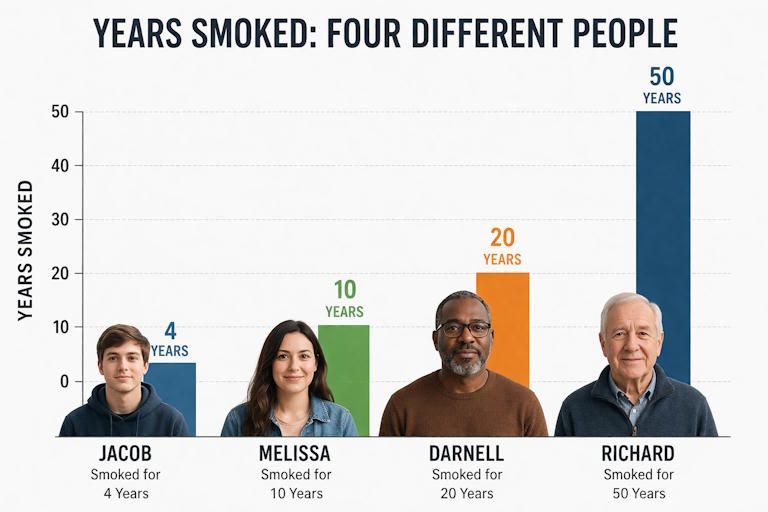
Does it matter how long you’ve been smoking?
Usually, yes.
The longer a habit has been reinforced, the more likely it is that it has settled into routine, expectation, and emotional patterning.
That does not mean long-term smokers cannot quit.
It means their smoking may be attached to more layers.
For example, if you have spent years smoking:
- during your commute
- on breaks
- after arguments
- with coffee
- after meals
- when the house finally gets quiet
then quitting is not just about stopping nicotine. It is also about changing what those moments mean. That is one reason session count cannot be reduced to a perfect formula.
Does it matter if you’ve tried to quit before?
Yes, and sometimes more than people realize.
If you have tried to quit before and keep relapsing in the same scenes, that tells you something important: the pattern is not random.
Maybe it is:
- the drive home
- the end of the workday
- stress after dealing with people
- one private moment at night
- the feeling that something is missing without the cigarette
That is why repeated failed attempts matter. They often reveal that smoking has become attached to certain emotional and situational loops.
Does that mean more sessions are always better?
Not automatically.
More is not always better.
But “one and done” is not always the most credible expectation either.
A better way to think about it is this:
The right number of sessions is the number that gives the pattern enough support to actually shift.
Sometimes that may be relatively brief. Sometimes it takes reinforcement. Sometimes what matters most is not the raw number but whether the person is working on the real triggers instead of just trying to white-knuckle through them.
That is a more useful mindset than chasing a magic number.
What is usually happening across multiple sessions?
This is where the question gets more practical.
People often imagine multiple sessions mean repeating the same experience over and over. But that is not usually the most helpful way to think about it.
A short series of sessions may help with things like:
- identifying the strongest triggers clearly
- reducing the emotional pull of smoking
- reinforcing a different internal response
- working through relapse points
- strengthening the non-smoker identity
- giving the new pattern more repetition than the old one has had recently
Your supporting materials already describe hypnosis sessions as involving intake, focused relaxation, suggestion work, and follow-through rather than a vague one-off experience.
That process tends to sound much more believable to skeptical adults than the idea of instant transformation. If you want the full session walkthrough, What Happens in a Quit Smoking Hypnotherapy Session in Columbus? should be one of your next clicks.
Is it a red flag if someone promises one session will fix everything?
It can be.
Not because fast results are impossible for every person. But because absolute promises usually make a complex habit sound simpler than it really is.
A serious provider should make room for variability.
They should be able to explain:
- why results differ
- why some people need reinforcement
- what kinds of patterns tend to be more stubborn
- what a realistic process looks like
That kind of honesty builds more trust than a perfect headline.
What if you are worried multiple sessions will mean a huge commitment?
That is a fair concern.
A lot of people hear “multiple sessions” and immediately imagine something indefinite, expensive, or too time-consuming for real life.
But that is exactly why it helps to think in terms of a short, focused process instead of a dramatic open-ended commitment.
This is not about signing up to rethink your whole life forever.
It is about giving a real habit pattern enough attention to actually change.
If cost is part of the anxiety, come learn more here: How Much Does Quit Smoking Hypnosis Cost in Columbus, Ohio?

Does the type of smoker you are affect how many sessions you may need?
Very often, yes.
Someone whose smoking is mostly situational may experience the process differently from someone whose smoking is deeply tied to:
- chronic stress
- emotional regulation
- identity
- loneliness
- long-term daily repetition
- multiple failed quit attempts
That is one reason one-size-fits-all promises often feel off.
If your smoking is deeply woven into how you handle hard moments, it makes sense that you may need more reinforcement than someone whose pattern is narrower.
That is not failure.
That is context.
What if your biggest trigger is stress?
Then the process may need to do more than simply target the cigarette.
If smoking has become your default reaction to pressure, resentment, overwhelm, overstimulation, or emotional exhaustion, then quitting may involve changing what your mind expects to happen in those moments.
That usually takes more honesty than heroics.
And for some people, it may take more than one session to loosen a long-practiced response to stress.
What if you just want to know whether this is realistic for your life in Columbus?
That is probably the right question.
Because most adults looking for quit smoking hypnotherapy in Columbus are not trying to add complexity to their lives. They are trying to reduce it.
They are working. Parenting. Commuting. Managing schedules. Trying to function.
That is one reason private remote sessions can matter so much. They can make the process feel possible without turning it into another logistical burden.
If you want a clearer look at the overall approach and next steps, check out out: Quit Smoking Columbus Hypnotherapy.
So what is a better expectation to bring into this?
A better expectation is not:
“How many sessions until I’m magically done forever?”
A better expectation is:
“How many sessions might it take to help me meaningfully change the pattern that keeps pulling me back in?”
That is a stronger question because it reflects real life.
If smoking is:
- automatic
- repetitive
- emotional
- deeply tied to routine
then it makes sense to treat the process with enough seriousness to allow reinforcement. That is not pessimistic.
It is practical.
What should you do if you’re still unsure?
Do not force yourself into certainty before you have enough information.
Instead, ask:
- Does this provider sound realistic?
- Do they explain the process clearly?
- Do they understand relapse and triggers?
- Do they sound like they specialize in this, or just list it among many services?
- Does the idea of a short, focused process feel workable for you?
That will usually tell you more than obsessing over one perfect number.
What is the bottom line?
The bottom line is that quit smoking hypnotherapy usually should not be viewed as a guaranteed one-session event.
A more realistic expectation is that multiple sessions are often needed, and that the exact number depends on how your smoking pattern is structured, how deeply it is tied to stress and routine, and whether you have had repeated relapse before, and its a small price to pay for fully-quitting the habit!
That is not bad news.
It is honest news.
And if you are someone who is serious about quitting, honest is usually what you want most.

Ready to Take the Next Step?
If you are tired of repeating the same smoking pattern and want a more focused, private, and professional path forward, Quit Smoking Columbus Hypnotherapy is here to help.
Start with the main overview on Quit Smoking Columbus Hypnotherapy if you want to see the full approach in one place.
Curious to know more? Give us a call at 614-467-8445.
Have questions or ready to schedule?
Send us a brief message here.
FAQ Section
How many quit smoking hypnotherapy sessions does it usually take?
There is no one universal number for everyone. Multiple sessions are often needed, and the exact number varies depending on the person and the smoking pattern.
Is one quit smoking hypnotherapy session usually enough?
Not always. Some people may respond quickly, but a more realistic expectation is that a short process with reinforcement is often more credible than a one-session promise.
Why can session count vary so much from person to person?
Because smoking habits differ. Some people have a narrower trigger pattern, while others have smoking tied to stress, routine, identity, and repeated relapse situations.
Does it matter if you’ve failed to quit before?
Yes. Repeated relapse often means the habit is tied to specific emotional or situational loops, which may require a more reinforced process.
Are sessions usually long?
Your supporting materials indicate sessions often last around an hour, which helps set a realistic expectation for the time involved.
Can quit smoking hypnotherapy be done remotely in Columbus?
Yes. Private remote sessions can make the process more convenient and realistic for busy adults in Columbus and nearby suburbs.
Quit Smoking Columbus Hypnotherapy Blog